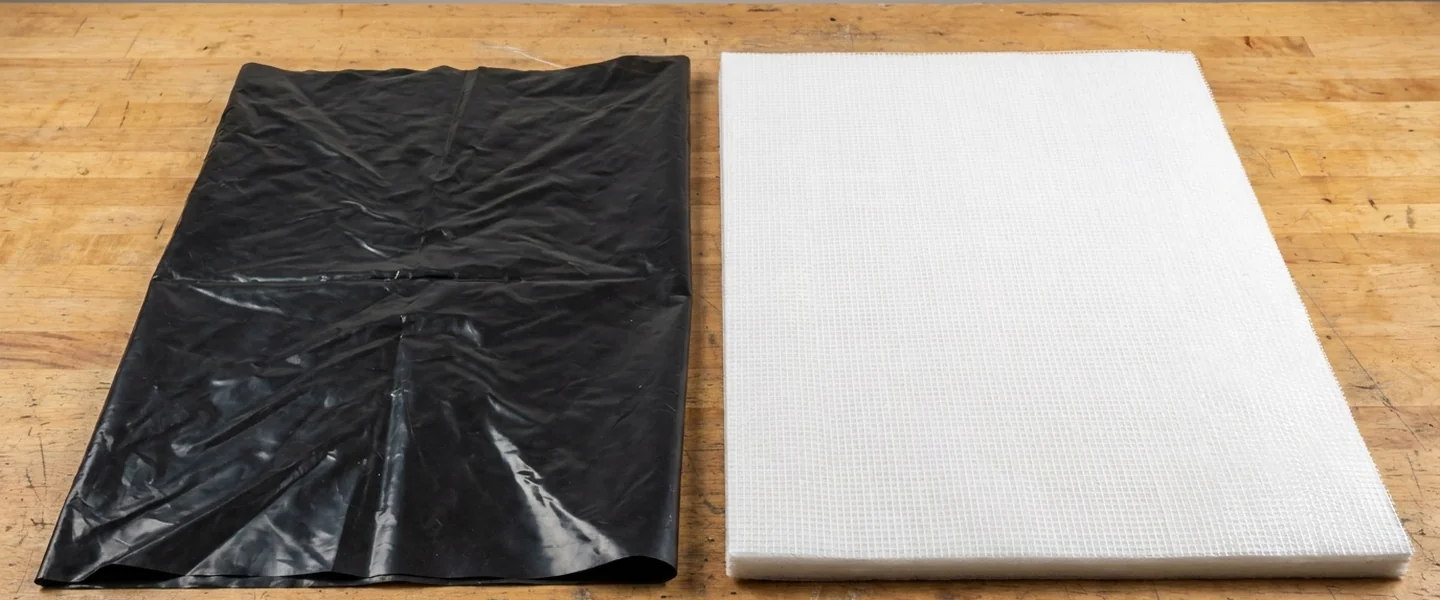
Crawlspace Vapor Barrier: 6-mil vs 20-mil (Why It Matters)
Locally based crawl space specialists serving the Richmond metro since 2019.
- Licensed & Insured in Virginia
- Locally Owned, Richmond-Based
- 25-Year Warranty on Encapsulation
- Free On-Site Estimates
- 0% Financing Available
Walk into any big-box home-improvement store in the Richmond metro and you’ll see 6-mil black polyethylene vapor barrier sold by the roll. The same store will tell you it’s “code minimum” for crawlspace use. Drive across town and visit a crawlspace specialist’s shop and you’ll find 20-mil reinforced vapor barriers costing significantly more per square foot. Both products technically prevent vapor transmission. So why does the thickness matter? Why do specialists recommend the 20-mil product even though it costs three to four times what the 6-mil costs? This post breaks down the difference and explains why the 20-mil is the only product we install.
What “Mil” Actually Means
Mil is a unit of thickness equal to one-thousandth of an inch. So a 6-mil sheet is 0.006 inches thick — about the thickness of two sheets of standard printer paper stacked. A 20-mil sheet is 0.020 inches thick — closer to the feel of a thin floor tile. The thickness affects three things: vapor permeance (how much moisture passes through), tear resistance (how easy it is to puncture during install and afterwards), and lifespan (how long the material retains its properties before degradation).
Vapor Permeance
This is the technical reason the thicker barrier matters less than people think. Both 6-mil and 20-mil polyethylene are considered Class I vapor retarders (permeance less than 0.1 perm) and both effectively block vapor diffusion through the sheet itself. So on the vapor transmission alone, the 6-mil performs about as well as the 20-mil when both are intact. The catch: “when both are intact” is the operative phrase.
Tear Resistance and Real-World Durability
Here is where the 20-mil reinforced product wins decisively. The 6-mil polyethylene punctures easily — a stray screw, a misplaced foot, a dragged ladder, a curious raccoon, a rodent, a careless pest-control technician — and once punctured, the integrity of the vapor barrier is compromised. Worse, 6-mil polyethylene gets brittle with age and starts cracking from the seams outward within 5-7 years in the Richmond climate. We routinely pull out 6-mil sheeting from 1990s subdivisions in Glen Allen and Short Pump where the material has degraded to the consistency of cracker.
The 20-mil reinforced product (Stego Wrap is the industry leader) has a polyester-mesh reinforcement layer embedded between two polyethylene layers. This makes it dramatically more puncture-resistant and gives it a 25-year manufacturer warranty against material defect. Real-world lifespan in a sealed crawlspace is 30+ years — effectively the lifespan of the home for most Richmond owners. The cost premium pays back the first time someone (HVAC tech, plumber, pest-control tech, you) walks across it without destroying it.
Seam Integrity
The 6-mil product is too thin to hold a butyl-tape seam reliably. The thin substrate fails before the tape adhesion does, so seams crack open within a few years of install. The 20-mil reinforced product has enough substrate thickness for proper butyl-tape adhesion and seam integrity that lasts decades. In a sealed crawlspace with a dehumidifier, an intact seam matters more than the sheet thickness — and the 20-mil holds that seam.
Wall Coverage Detailing
For wall coverage, the 20-mil’s stiffness and durability matter even more. The barrier needs to run up the foundation walls 6-12 inches, be mechanically fastened with washered fasteners, sealed at the top edge with butyl tape, and integrated with any rigid foam wall insulation that goes over it. The 6-mil sheeting tears at fastener points, sags between fasteners, and pulls free over time. The 20-mil holds.
Cost Math Over Time
Here’s the cost math for a 1,800 sq ft Richmond-area crawlspace. A 6-mil install costs less on day one — the material is cheap, the labor is similar. But the 6-mil typically fails within 5-7 years in our Piedmont climate (seam separation, puncture damage, embrittlement), at which point you’re paying for a full re-do: pulling the old material, replacing with new, redoing the dehumidifier setup. Total cost over 15 years: significantly higher than a single 20-mil install up front. The 20-mil typically lasts 25-30+ years with no replacement.
What the IRC Says
The International Residential Code (IRC R408.3) specifies that a crawlspace ground cover must be of a vapor-retarder material. The code minimum is 6-mil, but the code is silent on lifespan and durability — it’s a one-time-of-install standard. Building codes are minimums, not best practice. The Richmond metro’s climate, soil, and termite pressure argue for the 20-mil upgrade even though it exceeds code.
What About Wall Coverage Only?
Some contractors offer a “wall coverage only” install with 6-mil on the floor and 20-mil on the walls. This is a halfway measure that almost always fails because the floor coverage is the substrate that takes the most foot traffic. We do not split-spec — every install uses 20-mil reinforced on the floor and the walls so the entire envelope has the same lifespan.
Reinforcement Matters
Within the 20-mil category, there’s a further distinction: reinforced vs. unreinforced. A reinforced 20-mil has a polyester or polypropylene mesh embedded in the polyethylene, which raises tear resistance dramatically. Unreinforced 20-mil is more durable than 6-mil but less durable than reinforced 20-mil. We install reinforced exclusively (Stego Wrap is our preferred brand for this reason).
What About Even Thicker (40-mil, 60-mil)?
You can buy 40-mil and 60-mil products, primarily marketed for commercial or extreme applications. For residential crawlspaces in the Richmond metro, 20-mil reinforced is the sweet spot — durable enough to last the life of the home, flexible enough to install around piers and irregular geometry, and cost-effective compared to the heavier products. The 40-60 mil products are overkill for residential and add cost without proportional benefit.
Common Misconceptions About Vapor Barrier Thickness
“6-mil is fine because it’s code.”
Code is a minimum, not a recommendation. The Richmond Piedmont climate’s humidity, termite pressure, and soil moisture argue for exceeding code minimums.
“The thicker barrier is just upselling.”
Sometimes it is, when sold by a national franchise as part of a “platinum tier” package. When sold as a single line item with documented performance and warranty, the 20-mil is genuinely the right material for the Richmond environment.
“I can lay down 6-mil myself and save thousands.”
You can. You will not properly seal the seams, properly detail around piers, properly run up the walls, or properly tape to manufacturer specs. The install detail matters as much as the material, and a DIY 6-mil install almost always fails within 5 years.
Bottom Line
For crawlspaces in the Richmond metro, 20-mil reinforced vapor barrier (Stego Wrap or equivalent) is the right material. The cost premium over 6-mil pays back the first time someone walks across it without puncturing it, and the 25-year manufacturer warranty plus 30+ year real-world lifespan means most Richmond homeowners never replace it again. Call (804) 979-2406 for a free 30-minute inspection that includes a written estimate with the exact material specified.
Service Areas We Cover
We serve Richmond and the entire metro area. Click your suburb for local details and our typical findings in your housing stock:
Free Crawlspace Inspection in Richmond
Same-week appointments. No high-pressure sales. Serving Richmond and surrounding areas including Henrico, Chesterfield, Glen Allen, Midlothian, Mechanicsville, Bon Air, Tuckahoe, Short Pump.