Encapsulation vs Closed Crawl Space: What’s the Difference?
Locally based crawl space specialists serving the Richmond metro since 2019.
- Licensed & Insured in Virginia
- Locally Owned, Richmond-Based
- 25-Year Warranty on Encapsulation
- Free On-Site Estimates
- 0% Financing Available
“Encapsulation” and “closed crawl space” get used interchangeably in marketing copy, but they’re not the same thing. The distinction matters because what you actually want in a Richmond-area home is a closed crawl space, which is a building-code defined configuration, and encapsulation is the most common method of achieving it. Asking for “encapsulation” without specifying the configuration can leave you with a half-finished install. This post unpacks the terminology and explains what to ask for.
What “Closed Crawl Space” Means
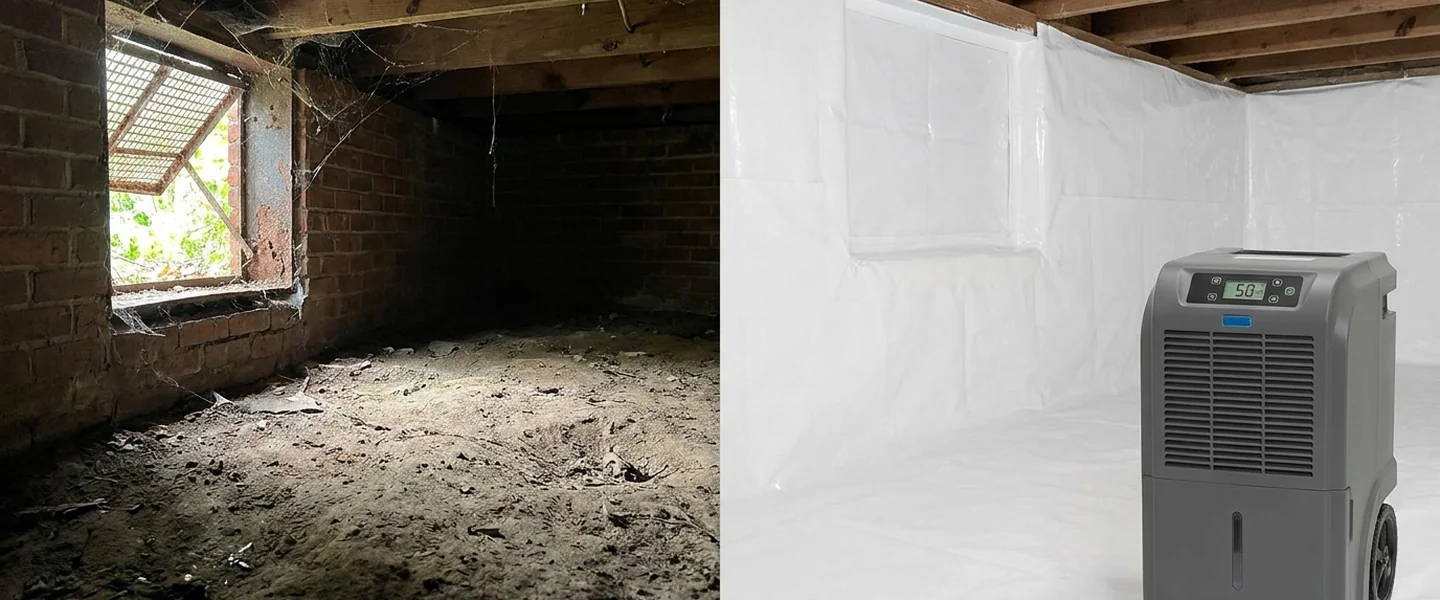
A closed crawl space (sometimes called a “sealed crawl space” or “unvented conditioned crawl space”) is a building configuration defined in the International Residential Code (IRC R408.3). It is a crawlspace with: a continuous vapor retarder across the soil, foundation walls insulated to a specified R-value, sealed (not vented) foundation walls, and mechanical conditioning of the air via a dehumidifier, supply air from the HVAC system, or exhaust to outside. The closed crawl space is the only configuration the IRC explicitly approves for high-humidity climates like central Virginia.
What “Encapsulation” Means
Encapsulation is the method of achieving the closed crawl space configuration. It’s the install process — laying the vapor barrier, sealing the walls, sealing the vents, adding the dehumidifier. Encapsulation as a process delivers the closed crawl space as an outcome. When done right, the two terms describe the same finished installation. When done wrong, “encapsulation” gets sold as a partial install (just the vapor barrier, no dehumidifier, vents left open) that doesn’t actually deliver a closed crawl space.
Why the Distinction Matters in Richmond
The Richmond Piedmont climate is exactly the case where the IRC code wrote the closed-crawl-space provision. Central Virginia summer humidity above 70% will defeat any partial install — a vapor barrier alone, with foundation vents still open, brings outside humidity in through the vents while the barrier stops soil moisture. Net effect: the crawlspace still runs at 70-80% RH all summer, mold still grows on the joists, and the homeowner who paid for “encapsulation” gets a year-three failure they didn’t expect. The closed crawl space is the only configuration that works in our climate, and the full install is the only way to get there.
What a “Half-Encapsulation” Looks Like
You’ll occasionally see quotes in the Richmond metro that include a vapor barrier on the soil but leave the vents open, omit the dehumidifier, or skip wall insulation. The quote will use the word “encapsulation” but the finished install is not a closed crawl space. Performance: the crawlspace still cycles outdoor humidity in summer, still leaks conditioned air in winter, still grows mold in the late summer humid months. Cost: cheaper on day one. Real-world result: the homeowner pays again in year three for the parts that were skipped originally, plus pulls out and replaces materials that have already degraded.
The Four Components of a Real Closed Crawl Space
1. Continuous vapor retarder on the soil. 20-mil reinforced (Stego Wrap is our standard) across the soil, run up the walls 6-12 inches, mechanically fastened, all seams taped.
2. Sealed foundation vents. Existing vents covered from the inside with insulated covers; the crawlspace no longer exchanges air with outdoors through the perimeter.
3. Foundation wall insulation. R-10 rigid foam board (Owens Corning FOAMULAR or equivalent) on the interior of the foundation walls, with sealed joints and a termite-inspection gap at the top.
4. Mechanical conditioning. Commercial dehumidifier (Aprilaire 1820 or Santa Fe Compact70) on a dedicated circuit with permanent condensate drainage, OR (less commonly) HVAC supply air ducted to the crawlspace with a return path. We use dehumidifiers for almost all Richmond-area work because they’re more energy-efficient and don’t require modifying the HVAC system.
The Three Variations
Within the closed crawl space category, there are three IRC-approved approaches:
Approach 1: Dehumidifier conditioning. The crawlspace gets a commercial dehumidifier that holds humidity at 50-55% RH. This is the most common approach for retrofit jobs in the Richmond metro and the one we use almost exclusively.
Approach 2: HVAC supply. Supply air from the home’s HVAC system is ducted into the crawlspace, with a return path back to the conditioned space. Less common in retrofits because it requires HVAC modifications.
Approach 3: Exhaust to outside. A continuous-run exhaust fan moves air from the crawlspace to outside. Rare in central Virginia because it pulls makeup air from the conditioned home, which can create combustion-air problems with gas appliances.
The Code Compliance Question
IRC R408.3 requires a closed crawl space to meet specific provisions for the configuration to be approved. A half-encapsulation that leaves vents open does not meet the code provisions for an unvented crawl space, and depending on local enforcement may also fail to meet the code provisions for a vented crawl space (because of the new vapor barrier changing the moisture dynamics). The right install is fully closed and code-compliant; partial installs sometimes fail inspection if a building official walks the space.
What to Ask the Contractor
- Will the finished install be an IRC R408.3-compliant closed crawl space?
- Are the vents sealed (not just covered with screen)?
- Is the dehumidifier included in the quote, with brand, model, and capacity specified?
- Is the wall insulation included in the quote, with material and R-value specified?
- What’s the target humidity setpoint, and how is it verified at the end of the install?
- How does the install hold up to the next humid summer? What’s the warranty if it doesn’t?
Cost Math: Full Closed vs. Half-Encapsulation
A full closed-crawl-space install costs more upfront than a vapor-barrier-only install in the Richmond metro. The difference is real and worth asking about. But the half-install fails in our climate within 2-5 years, at which point the homeowner is paying for the missing components (dehumidifier, vent sealing, wall insulation) plus replacement of materials that have already started to degrade. Over a 15-20 year horizon, the full closed crawl space costs less than the half-install plus its eventual catch-up. Up front, the full install costs more. Over time, it’s cheaper.
Why Some Contractors Sell the Half-Install
Two reasons. First, the upfront price is more competitive on a quote sheet — homeowners comparing dollar figures will sometimes pick the cheaper quote without realizing the scope difference. Second, the half-install creates repeat business — the contractor returns in year three to “upgrade” the install with the components that should have been there originally. Reputable contractors don’t sell the half-install for this reason; transient or franchise contractors sometimes do.
Common Misconceptions About Closed Crawl Spaces
“A closed crawl space will be unsafe — moisture has to go somewhere.”
The dehumidifier (or HVAC supply) is the path. The moisture is captured by the dehumidifier and drained to a sump or exterior drain. The crawlspace runs drier than an open vented crawl space, not wetter.
“Sealed crawl spaces void warranties.”
The opposite. Most modern foundation, structural, and termite warranties are written assuming a properly sealed crawl space, not an open vented one. Vented crawl spaces in our climate are increasingly the warranty-disqualifying configuration.
“My pest-control company won’t be able to inspect for termites.”
They can — the install includes a 4-6 inch termite-inspection gap at the top of the wall insulation, designed to satisfy pest-control inspection requirements. The closed crawl space is fully compatible with annual WDO inspections.
“Encapsulation is just upselling.”
The half-install version of “encapsulation” can be upselling if it leaves out the components that make the install actually work. The full closed-crawl-space install is the IRC-defined, climate-appropriate configuration for central Virginia and is not upselling — it’s the right scope.
Bottom Line
What you want in a Richmond-area home is a closed crawl space, which is a complete sealed and conditioned configuration with vapor retarder, sealed vents, wall insulation, and mechanical conditioning. “Encapsulation” is the install process that delivers it — when the scope is complete. Ask the contractor for an IRC R408.3-compliant closed crawl space, get the scope spelled out in writing, and you won’t be surprised in year three. Call (804) 979-2406 for a free 30-minute inspection and a written, itemized scope for a complete closed crawl space.
Service Areas We Cover
We serve Richmond and the entire metro area. Click your suburb for local details and our typical findings in your housing stock:
Free Crawlspace Inspection in Richmond
Same-week appointments. No high-pressure sales. Serving Richmond and surrounding areas including Henrico, Chesterfield, Glen Allen, Midlothian, Mechanicsville, Bon Air, Tuckahoe, Short Pump.